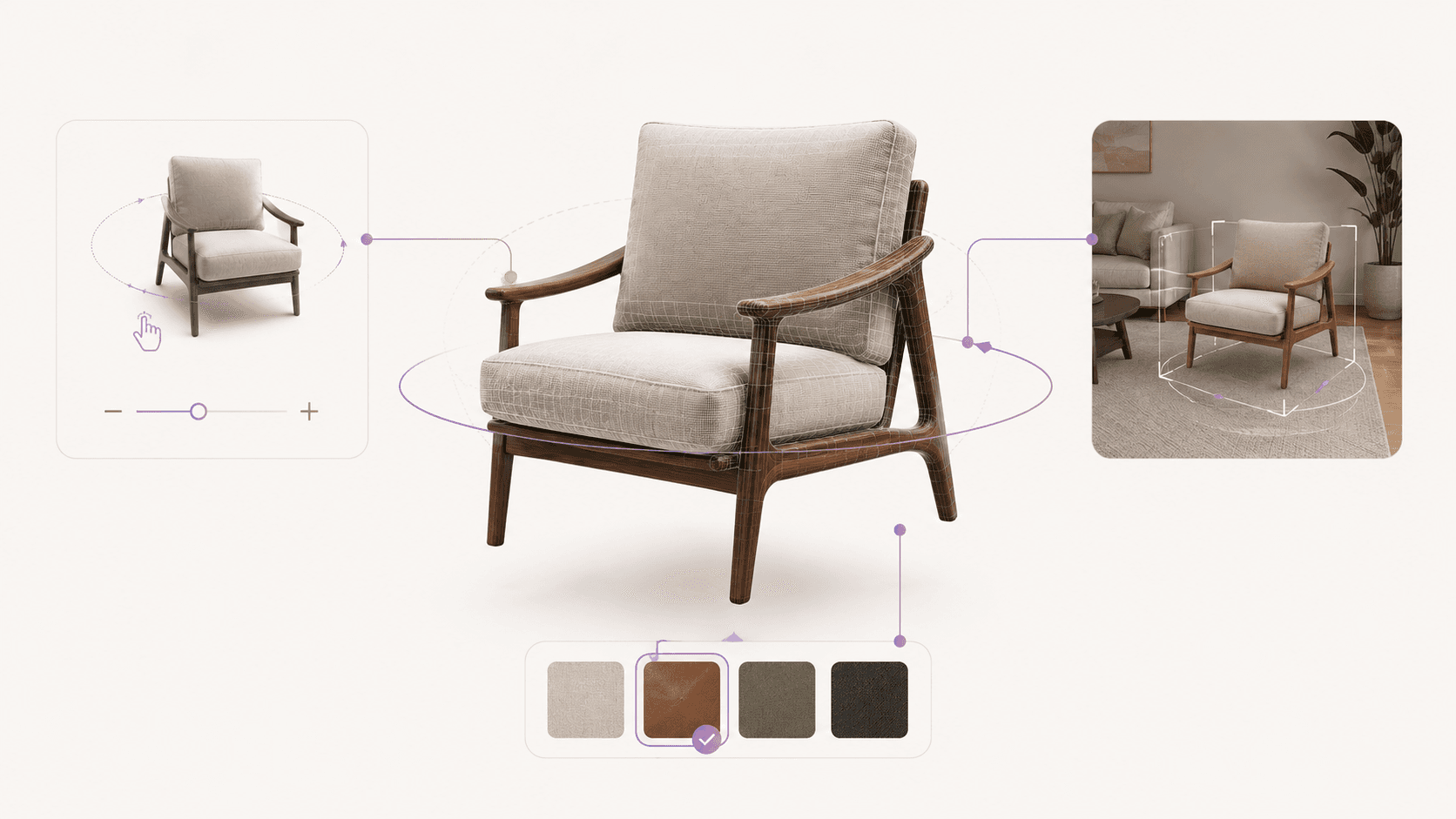
The numbers behind 3D product visualization aren't borderline. They're some of the most lopsided in ecommerce — which makes the gap between what the data says and what most stores actually do the real opportunity here.
There's a strange thing about 3D product configurators: almost no one disputes that they work, and almost no one uses them. The benefits show up across every metric an operator cares about — conversion rate, return rate, time on page, buying confidence, average order value — and yet the overwhelming majority of online stores still ship the same four-to-six static photos they did a decade ago.
That mismatch is the upside. When a proven lever is sitting in plain sight and your competitors haven't pulled it, the cost of adopting it isn't just the lift you gain — it's the lift they don't. Below is the actual data, broken down by the delta it moves.
The delta at a glance
Metric | What 3D does | Source |
|---|---|---|
Conversion rate | Avg 94% increase for merchants using 3D commerce | Shopify |
Returns | Up to 40% reduction in product returns | Shopify |
Interaction rate | 82% of shoppers engage the 3D view when it's available | Industry survey |
Dwell time | 34% interact for 30+ seconds; ~20s avg per session | Industry data |
Buying confidence | 66% say a 3D configurator increases purchase confidence | Industry survey |
Willingness to pay | 40% of shoppers will pay more for a 3D experience | Shopify (2021 study) |
Average order value | +13% AOV, +21% revenue per visit (CB2 case) | Retail Customer Experience |
Format preference | 95% prefer interactive 3D over static video playback | Industry data |
The rest of this post unpacks each delta and why it moves.
Delta 1 — Conversions: roughly a doubling
The headline figure is the one Shopify publishes directly: merchants using 3D commerce see an average 94% increase in conversions compared to static product pages. On the same traffic, with the same prices, that's close to a doubling of the rate at which visitors become buyers.
It holds at the individual-brand level too. Fashion label Rebecca Minkoff, on Shopify, reported shoppers were 27% more likely to place an order after interacting with a product in 3D — and 65% more likely after viewing it in AR. Furniture retailer CB2 reported product pages with 3D and AR drove 21% higher revenue per visit.
The mechanism is simple: conversion is mostly a confidence problem. A shopper who can fully inspect what they're buying hesitates less, and less hesitation converts more.
Delta 2 — Returns: the margin you're handing back
Returns are the most underrated line item in this entire conversation, because returns are pure margin destruction — you pay to ship out, pay to ship back, and frequently can't resell. Shopify has reported a 40% reduction in returns for products offered with 3D visualization, and 89% of retailers in industry surveys say 3D content is important specifically for reducing returns.
The reason maps directly to why people return things. The leading cause of returns is a gap between expectation and reality — the item is a different size, scale, or finish than the photo implied. A 3D model closes that gap before checkout. The customer who can see true proportions and material isn't surprised at the door, so they don't send it back. Every point you shave off your return rate drops almost entirely to the bottom line.
Delta 3 — Site interactions: 3D earns its place on the page
A common objection is that 3D is a gimmick shoppers ignore. The interaction data says the opposite. When a product page includes a 3D asset, 82% of shoppers actively engage it — they rotate, zoom, and explore rather than scroll past. 34% spend more than 30 seconds inside the 3D view, with an average interaction of around 20 seconds.
That matters because of what those seconds do. Time spent meaningfully interacting with a product is a leading indicator of intent, and it pulls down bounce rate while pulling up the depth of the session. And when shoppers are asked to choose, 95% prefer interactive 3D content over a static video playback — they want to control the view, not watch one. A 3D configurator isn't decoration that sits unused; it's the part of the page shoppers actually reach for.
Delta 4 — Product engagement: closing the gap retail has and ecommerce doesn't
This is the structural advantage most operators miss, and it's the most important one.
Walk into a physical store and the single most powerful thing that happens is tactile: you pick the product up. You turn it over, feel the weight, check the finish. That act of handling does something measurable to purchase behavior — touching a product increases the sense of ownership and how much a shopper values it, which is a large part of why retail converts the way it does.
Ecommerce has never had that. As Shopify puts it plainly, online shoppers still can't interact with products in person before buying, and that absence directly drags on conversion and inflates returns. A flat photo gallery is a fundamentally lower-engagement medium than a shelf — there's nothing to do.
A 3D product configurator is the closest the web has come to handing that interaction back. Rotating, zooming, and configuring a model is the digital analog of picking the product up off the shelf. It's why 66% of shoppers say they'd be more interested in shopping a site that offered 3D and AR instead of images, and why industry data shows 3D experiences drive roughly double the engagement of their non-3D equivalents. You're not adding a feature — you're restoring the one sensory advantage retail has held over ecommerce since ecommerce began.
Delta 5 — Product information: from six angles to every angle
Every static product page makes a silent decision on the shopper's behalf: it picks which four-to-six angles you're allowed to see. If the photographer didn't shoot the back, the underside, or a close-up of the seam, that information simply doesn't exist for the buyer.
A 3D model removes the brand from that decision. The shopper self-serves exactly the angle, zoom level, and detail they care about — true scale, the texture of the material, how the lid sits, what the hardware actually looks like. This is why 66% of shoppers say a 3D configurator increases their buying confidence: confidence is just information uncertainty resolved, and infinite angles resolve far more of it than a fixed gallery ever can.
It also explains the returns delta from the other direction. Most "wrong size / not as pictured" returns are really information failures — the page didn't carry the detail the shopper needed, so they guessed, and guessed wrong. Complete product information at the moment of decision means fewer wrong guesses leaving the warehouse.
Other data-backed reasons to put 3D on the page
Beyond the five core deltas, a few more numbers round out the case:
Willingness to pay. A 2021 study cited by Shopify found 40% of online shoppers will pay more for a 3D experience — meaning 3D can lift price tolerance, not just conversion rate.
Average order value. CB2's 3D/AR product pages drove a 13% lift in average order size, partly because configurable 3D invites shoppers to explore (and buy) more variations.
AR compounds it. The same models that power your 3D viewer feed AR, where Rebecca Minkoff saw shoppers 65% more likely to order — letting buyers place the product in their own space closes the last gap a photo leaves open.
Competitive scarcity. The clearest argument is the adoption gap itself: the benefits are well-documented, yet very few stores have implemented 3D. Being early in your category is a moat that disappears the moment everyone catches up.
The compounding picture
Read individually, each delta is a reason. Read together, they compound. The same traffic converts at nearly double the rate, those orders carry a higher value, a meaningful share of them stop coming back as returns, and the shoppers who don't buy today leave with a stronger impression of the brand. There aren't many single changes to a product page that move that many metrics in the same direction at once.
The historical reason stores didn't act on this data was cost and turnaround — building 3D models meant agencies, studios, weeks of lead time, and four-figure quotes per product. That's the part that changed. Tools like Hangr use AI to turn your existing 2D product photos into interactive 3D models you can embed on a Shopify product page in minutes, with no 3D files, no designer, and no engineering. The data has been pointing one direction for years. The only thing that was missing was a way for normal stores to act on it.
Turn your product photos into 3D — start free on Hangr.
Frequently asked questions
How much do 3D product configurators increase conversions?
Shopify reports an average 94% increase in conversions for merchants using 3D commerce. Individual brands on Shopify, such as Rebecca Minkoff, have reported shoppers being 27% more likely to order after a 3D interaction and 65% more likely after AR.
Do 3D product models reduce returns?
Yes. Shopify has reported up to a 40% reduction in returns with 3D visualization, and 89% of retailers in industry surveys cite reducing returns as a key reason for adding 3D. Most returns stem from expectation gaps that complete 3D product information helps prevent.
Do shoppers actually use 3D viewers, or do they ignore them?
They use them. Industry data shows 82% of shoppers engage the 3D view when it's available, 34% interact for more than 30 seconds, and 95% prefer interactive 3D over static video playback.
Why does 3D engage shoppers more than photos?
A static gallery is passive — there's nothing to do. A 3D configurator restores the tactile, hands-on interaction that drives purchasing in physical retail but has always been missing online, which is why 3D pages see roughly double the engagement of non-3D equivalents.
Can 3D increase average order value, not just conversion rate?
It can. Shopify cites a study where 40% of shoppers said they'd pay more for a 3D experience, and furniture retailer CB2 reported a 13% lift in average order size on 3D/AR product pages.
Is it expensive to add 3D models to a Shopify store?
It used to be — traditional 3D modeling ran into four figures per product with weeks of turnaround. AI tools like Hangr now generate interactive 3D models from your existing 2D photos and embed them on Shopify in minutes, starting free.
Sources
Shopify — 3D Ecommerce: A New Era of Retail (94% conversion increase; 40% willing to pay more; 40% returns reduction; engagement and time-on-page lift): https://www.shopify.com/blog/3d-ecommerce
Shopify — The ROI on AR (Rebecca Minkoff: +27% order in 3D, +65% in AR, +44% add-to-cart): https://www.shopify.com/blog/ar-shopping
Industry survey data on 3D content (82% interaction rate, 34% 30s+ dwell, ~20s avg interaction, 66% confidence lift, 95% prefer 3D to video, 89% returns relevance): compiled in 16 Key Stats About 3D Content and Ecommerce, CGI Backgrounds: https://www.cgibackgrounds.com/blog/16-key-stats-about-3d-content-and-ecommerce-for-2025
CB2 average order value and revenue-per-visit lift, via Retail Customer Experience, cited in Reydar's 3D ecommerce benefits roundup: https://www.reydar.com/3d-model-products-for-ecommerce-sites-benefits/
Brands referenced are cited as examples of 3D and configurator adoption and outcomes across the ecommerce category. They are not Hangr customers, and no affiliation is implied.
No credit card. No engineering. 10 minutes from sign to live.
Start free, no credit card