
AI 3D product models are digital assets generated by machine learning systems that convert a text prompt or a single product photo into a fully textured, production-ready 3D object, often within a minute or so. That speed alone separates them from traditional 3D modeling, which can take a skilled artist days to complete. For ecommerce brand owners and product designers, the practical upside is immediate: richer product pages, AR-ready assets, and faster iteration cycles without hiring a 3D studio.
The two core creation workflows are text-to-3D and image-to-3D generation. Text-to-3D lets you describe a product in natural language and receive a usable mesh. Image-to-3D, the more precise route for product work, reconstructs geometry and materials from one or more reference photos. Output files typically export in formats like GLB, USDZ, OBJ, and FBX, which plug directly into Shopify storefronts, Unity, and Unreal Engine 5 without conversion steps.
Key facts to know before you choose a tool:
Generation times vary considerably depending on object complexity, from very quick results for simple objects to longer times for complex scenes.
Top-tier tools output full PBR material maps (Albedo, Normal, Roughness, and Metallic) in one pass
Clean, high-resolution source images with clear backgrounds reduce generation errors
Export formats determine where models can be deployed: GLB for web viewers, USDZ for Apple AR, FBX for game engines
Integration with ecommerce platforms like Shopify, WooCommerce, and Magento is now standard for leading tools
Table of Contents
Which AI 3D generation tools are worth your attention in 2026?
Expert insights on where AI 3D modeling is heading for ecommerce
Hangrsolutions turns your product photos into a 3D storefront experience
What makes AI 3D product models production-ready?
The gap between a "generated" model and a production-ready one comes down to geometry quality, material accuracy, and mesh integrity. Most early AI tools produced soft edges and collapsed thin walls because they processed everything in a single pass. The better systems now use a two-stage approach: the first stage builds overall shape, and the second sharpens bevels, edges, and fine detail separately. That architecture is why two-stage generation consistently outperforms single-pass pipelines on professional evaluations.
Material quality is the other half of the equation. A model that ships with only an RGB texture layer requires manual cleanup before it can go into a real product workflow. Tools that generate full PBR material maps, including Albedo, Normal, Roughness, and Metallic channels, in a unified generation step eliminate that cleanup sprint entirely.
Key production-readiness features to look for:
Quad remeshing: Converts triangulated AI output into cleaner quad topology for animation and further editing
Printability checks: Automated mesh repair catches non-manifold edges and other issues that would cause 3D print failures
Auto-repair: Fixes mesh errors without manual intervention, saving hours on complex models
Multi-view input support: Feeding the AI multiple angles of the same product improves shape accuracy and proportion consistency
PBR map generation: Full material sets in one pass, not derived from a single RGB layer
Pro Tip: Before uploading a product photo for AI 3D generation, remove the background and shoot against a neutral surface. Automated computer vision systems score source images for clarity before generation begins, and a cleaner input directly reduces artifacts in the output.
Source image quality has an outsized effect on output precision. Automated pipelines rate incoming photos for background simplicity and sharpness, then use that score to adjust the generation process. A blurry or cluttered product shot does not just produce a worse model. It creates more manual repair work downstream, which defeats the purpose of AI generation entirely.

Where are brands actually using AI-generated 3D models?
Ecommerce is the clearest use case. Interactive 3D viewers on product pages let shoppers rotate, zoom, and inspect items the way a physical store visit would. AR overlays take that further, placing a product in the shopper's own space before purchase. Brands selling furniture, footwear, jewelry, and electronics have seen measurable engagement gains from interactive 3D product pages) compared to static photography.
AI-driven ecommerce pipelines can now automate the full journey from a product photo or marketplace URL to a web-optimized, interactive 3D model with hotspots, compressing what once took days into minutes.
Game development studios use AI 3D generation to accelerate asset pipelines. Concept art or reference photos convert directly into GLB or FBX files that drop into Unity or Unreal Engine 5 with PBR materials already applied. That removes a significant bottleneck between the art direction phase and in-engine testing.
Physical production is another growing application. Designers use AI-generated models as starting points for 3D printing, running printability checks and mesh repairs before sending files to a printer. Marketing teams generate product renders and configurator assets from the same source models, so one AI generation session can feed multiple channels simultaneously.
Ecommerce: Interactive viewers, AR previews, and 360-degree product spins
Game development: Rapid prop, character, and environment asset generation from concept art
3D printing and manufacturing: Print-ready models with automated mesh validation
Marketing and advertising: High-quality renders and configurator assets from a single source file
Animation: Base meshes for rigging and motion work, reducing manual modeling time
Which AI 3D generation tools are worth your attention in 2026?
The tools that matter for ecommerce and product design share a common profile: fast generation, production-grade output, and export formats that fit real workflows. Here is where the notable platforms stand.
3D AI Studio focuses on accessibility, offering text-to-3D and image-to-3D generation with a browser-based interface that requires no software installation. It targets brand owners who need usable assets quickly without a technical background. Export options cover the standard formats, and the platform has attracted attention from ecommerce teams looking for a low-friction entry point.

Meshy has built a reputation for fast mesh generation and a broad feature set that includes AI texturing, auto-rigging, and an API for pipeline integration. Its automated printability checks and mesh repair tools make it a practical choice for teams that need models for both digital display and physical prototyping. G2 and Trustpilot reviews consistently highlight its speed and the quality of its texture output for game and ecommerce assets.
Hangr takes a different approach, built specifically for ecommerce product visualization rather than general 3D creation. It converts product photos into web-optimized 3D models and deploys them through embedded interactive viewers on Shopify, WooCommerce, Magento, Wix, and BigCommerce stores. The platform supports AR-ready output, product variants, and hotspots, and adds real-time analytics on how shoppers engage with 3D content. For brand owners who want 3D product visualization without managing a 3D pipeline, Hangr is purpose-built for that outcome.
Across all three, the practical differentiators are:
Export format range (GLB, USDZ, OBJ, FBX, and for robotics workflows, URDF)
Whether PBR material maps are generated natively or derived from RGB textures
Ecommerce platform integration depth
Parametric controls for adjusting geometry without full regeneration
API access for teams building automated pipelines
Expert insights on where AI 3D modeling is heading for ecommerce
The most consequential shift in AI 3D modeling right now is the move toward view-conditioned generation. Instead of requiring a full photoshoot from every angle, leading systems can reconstruct complete 3D geometry from as few as one to three images, predicting missing angles from what the model has learned about object structure. For ecommerce brands, that means a standard product photo is often enough to generate a usable 3D asset.
The shift from exhaustive photo capture to view-conditioned AI generation is removing the last major friction point between a product and its 3D representation online.
Parametric controls are becoming a standard expectation rather than a premium feature. Designers need to adjust specific geometry components, such as a handle shape or a surface curve, without regenerating the entire model. Parametric templates and multi-view inputs give teams that precision while keeping the speed advantage of AI generation. The combination of automation and targeted human editing is where the most efficient product design workflows are landing.
Production pipeline integration is accelerating. AI 3D generation is no longer a standalone prototyping step. Brands are connecting generation tools directly to their ecommerce platforms, so a new product photo can trigger an automated pipeline that produces a web-optimized 3D model, runs quality checks, and deploys an interactive viewer, all without manual handoffs. That kind of automated ecommerce 3D pipeline is what separates brands with fast product launch cycles from those still waiting on 3D artists.
Key trends shaping the field:
View-conditioned generation from minimal images is replacing exhaustive multi-angle capture
Full PBR material generation in one pass is becoming the baseline expectation, not a differentiator
Printability and mesh auto-repair are moving from optional features to standard pipeline requirements
Parametric editing controls are giving designers precision without sacrificing generation speed
Real-time analytics on 3D viewer engagement are informing product page optimization decisions
Hangrsolutions turns your product photos into a 3D storefront experience
Most AI 3D generation tools hand you a file and leave the deployment to you. Hangrsolutions does the opposite. It takes your existing product photos and converts them into web-optimized 3D models, then embeds interactive viewers directly into your Shopify, WooCommerce, Magento, Wix, or BigCommerce store. No 3D pipeline to manage. No developer required.
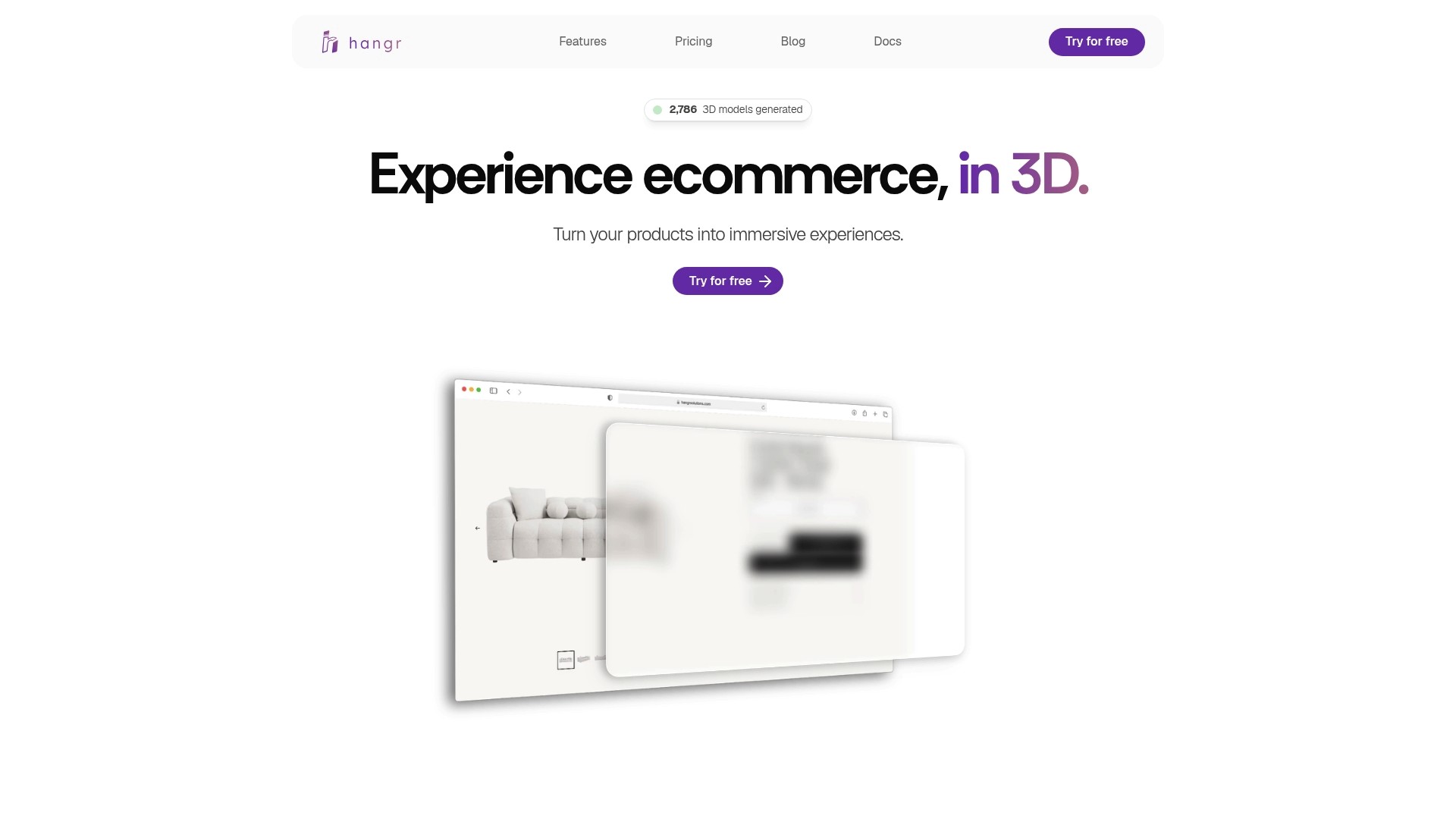
The platform supports AR-ready models, product variants, and hotspots across categories including furniture, footwear, jewelry, electronics, bags, toys, and appliances. Shoppers get a fitting-room-style experience: rotate, zoom, and place products in their own space before buying. Hangr also tracks how shoppers interact with every 3D viewer, giving you real engagement data to act on rather than guessing what drives conversion. Brands that have moved from static photography to interactive 3D product pages are seeing the difference in time on page and return rates. Start your free trial at Hangrsolutions and see what your product catalog looks like in 3D.
Key Takeaways
AI 3D product models generated from images or text are now fast enough, accurate enough, and production-ready enough to replace traditional 3D modeling in most ecommerce workflows.
Point | Details |
|---|---|
Generation speed | Leading tools complete models in under 30 seconds for simple objects, up to 60 seconds for complex scenes. |
PBR material output | Top tools generate Albedo, Normal, Roughness, and Metallic maps simultaneously, eliminating manual texture cleanup. |
Source image quality | Clean, high-resolution product photos with clear backgrounds directly reduce generation errors and repair time. |
View-conditioned AI | Modern systems reconstruct full 3D geometry from as few as one to three images, removing the need for exhaustive photo capture. |
Hangr | Converts product photos into web-optimized 3D viewers deployed directly on Shopify, WooCommerce, and other major ecommerce platforms. |
Recommended
No credit card. No engineering. 10 minutes from sign to live.
Start free, no credit card